Trump Pauses Hormuz Operation — Is the Iran Deal Finally Happening? Something happened on Tuesday evening that nobody saw coming. Not the analysts and the journalists camped outside the White House. Not even, it seems, the senior American officials who had spent the entire day describing Project Freedom as a matter of life and death for thousands of stranded sailors.
Trump paused it, just like that.
One day after launching a military operation to force open the Strait of Hormuz, the President of the United States posted on Truth Social that the whole thing was being put on hold. And the reason he gave stopped everyone in their tracks.
What Project Freedom Actually Was
To understand why this pause matters so much, you need to understand what Project Freedom was and why it was launched in the first place.
Roughly 23,000 sailors aboard vessels from 87 countries have been stranded in the Persian Gulf since Iran’s de facto closure of the Strait of Hormuz began in February 2026. At least 10 sailors have died as a direct consequence, according to the State Department. Twenty-three thousand sailors. Eighty-seven countries. Ten people are already dead. The closure of the Strait of Hormuz was not just a geopolitical problem. It was a humanitarian crisis affecting ordinary working people from dozens of nations who had nothing to do with the war and had simply been in the wrong place when it started.
Trump announced Project Freedom on Sunday evening, saying the US has assured countries whose vessels are stuck due to the war that it will guide their ships safely out of these restricted waterways. Two US Navy destroyers successfully transited the strait on Monday while fending off a barrage of small boats, missiles and drones. The operation was dangerous from the very first moment. Iran was not going to let American warships escort vessels through what it considers its controlled waterway without fighting back.
And then, 24 hours after it began, Trump stopped it.
Why Pakistan Is the Reason This Pause Happened
Here is the part of the story that every Pakistani needs to read carefully, because it is extraordinary.
Trump wrote on Truth Social: “Based on the request of Pakistan and other Countries, the tremendous Military Success that we have had during the Campaign against the Country of Iran and, additionally, the fact that Great Progress has been made toward a Complete and Final Agreement with Representatives of Iran, we have mutually agreed that, while the Blockade will remain in full force and effect, Project Freedom will be paused for a short period of time to see whether or not the Agreement can be finalized and signed.” Pakistan’s name. First. In Trump’s own words. On Truth Social. Before “other countries.” Before any other explanation. The Express Tribune
The President of the United States publicly credited Pakistan with convincing him to pause a military operation. Not NATO. Not the UN and not Saudi Arabia or the UAE. Pakistan. Prime Minister Shehbaz Sharif said on X that it is absolutely essential that the ceasefire be upheld and respected, to allow necessary diplomatic space for dialogue leading to enduring peace and stability in the region. Sharif said that. Trump listened. And then Trump acted on it.
That is not a small thing. That is Pakistan exercising genuine, measurable influence over American military decision-making in real time.
What Was Happening in the Strait When Trump Paused
The decision to pause did not come in a calm moment. It came in the middle of one of the most dangerous days the Strait of Hormuz had seen in weeks.
The United Arab Emirates said its air defences intercepted missile and drone attacks launched by Iran for a second consecutive day. At the same time, another commercial ship in the Strait of Hormuz reported that an unknown projectile struck it. Iran’s Islamic Revolutionary Guard Corps released a new map of the strait, expanded its claimed area of control, and warned vessels to stay within designated corridors or face a decisive response. Donald Trump warned that the United States would blow Iran off the face of the earth if it continued attacking US ships in the Strait of Hormuz. In that tense atmosphere, ships were getting hit, drones were being intercepted, Trump was issuing threats of annihilation, and Marco Rubio was describing stranded sailors as sitting ducks left for dead—Pakistan stepped in, made direct calls, and pushed for a pause. And it worked.
What Is the Iran Deal Being Discussed Right Now
This is where the story gets genuinely hopeful, though carefully so.
A one-page plan being floated internally contains provisions that have been at the heart of negotiations to end the conflict. The document would declare an end to the war while triggering a 30-day negotiation period on resolving sticking points, including on nuclear issues, unfreezing Iranian assets and future security in the Strait of Hormuz. One page. Thirty days. That is dramatically simpler than everything that has been attempted before. The first round of Islamabad talks tried to solve everything at once, in 21 hours, across hundreds of pages of proposals and counter-proposals. It failed.
This approach is different. Declare the war over. Open the strait. Then spend 30 days working out the harder details of the nuclear programme, frozen assets and long-term security arrangements with the immediate crisis resolved rather than looming over every conversation. The source familiar said it would include a discussion of a moratorium on uranium enrichment for a period of longer than 10 years. A previous US proposal had set it at 20 years. So America has moved from demanding 20 years to accepting “longer than 10 years.” That is a significant concession. It suggests Washington genuinely wants a deal and is willing to compromise to get one. Investing.com
Iran’s Revolutionary Guard on Wednesday said safe passage through the Strait of Hormuz would be provided, but it was not immediately clear how much the move would reopen the shipping route. With the end of the aggressors’ threats and the introduction of new procedures, the Revolutionary Guard’s navy command said it will facilitate safe and sustainable transit through the strait. Iran’s Revolutionary Guard is now talking about providing safe passage, something nobody expected to read this week.
But Trump Also Threatened to Resume Bombing
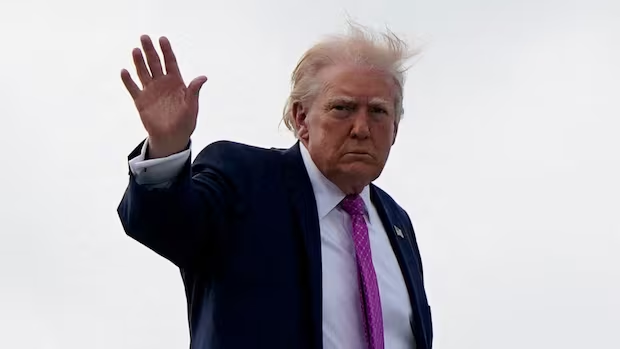
Here is where the story gets complicated again, because with Trump, it always does. Assuming Iran agrees to give what has been agreed to, which is perhaps a big assumption, the already legendary Epic Fury will be at an end, and the highly effective Blockade will allow the Hormuz Strait to be open to all, including Iran. If they don’t agree, the bombing starts, and it will be, sadly, at a much higher level and intensity than it was before, Trump wrote online Wednesday morning. Maximum pressure and diplomatic opening at exactly the same time. That is Trump’s signature style, and it is genuinely difficult to know how to read it. Is the threat real? Is it a negotiating posture? And is it aimed at Iran’s hardliners, who need to be able to say Iran did not cave to American pressure? Pakistan Today
Probably all three simultaneously. The ambiguity is the point. Iran will relate its response to mediating country Pakistan, Iran’s foreign ministry spokesperson said. Iran’s negotiators are discussing the end of the war, not the nuclear issue, which would come at a later stage of negotiations. Iran is going to give its answer to Pakistan. Not directly to America. Pakistan will carry it to Washington. The same channel that has been the backbone of this entire process from the very beginning is still the channel that matters most right now.
What This Means for Ordinary Pakistanis
For people sitting at home in Rawalpindi or Karachi watching petrol prices and electricity bills, here is the practical picture.
Brent crude has traded between 110 and 114 dollars per barrel during the episode, against an Iran war pre-conflict baseline near 80 dollars. Oil is still significantly above pre-war levels. As long as the Strait of Hormuz remains effectively closed, energy prices worldwide stay elevated, and Pakistan’s economy stays under pressure. Every day the uncertainty continues is another day of stress on Pakistan’s finances, the rupee, and the cost of living.
If the parties sign the one-page deal, open the 30-day negotiation window, and fully reopen the strait, the situation will bring substantial and relatively quick relief. Oil markets respond fast when certainty replaces uncertainty. Pakistan revises petrol prices weekly, so lower global crude prices will reflect within days of announcing a deal. For Pakistani families, the difference between a deal and no deal is not abstract; it directly affects the price of flour, electricity bills, and the daily cost of commuting to work.
Where Things Stand Right Now
As of today, May 7, Iran is reviewing the American proposal and is expected to give its answer to Pakistani mediators. Trump has paused Project Freedom but kept the naval blockade in place. The Strait of Hormuz is not fully open but Iran’s Revolutionary Guard has mentioned new procedures for safe passage. Oil is still above $110 a barrel. And Pakistan is still the only channel through which these two sides are communicating.
Trump touted the diplomacy Wednesday, saying the US has had very good talks with Iran over the past 24 hours. Very good talks. Iran’s response coming today through Pakistan. A one-page deal on the table. A 30-day window being offered. This is the closest this conflict has come to a resolution since it began on February 28. Nothing is guaranteed. Trump himself acknowledged that talks have previously fallen apart at the last minute. But the combination of a simplified proposal, a paused military operation, and active diplomatic engagement through Pakistan creates a window that did not exist even a week ago.
Whether that window gets used is the question that the next 24 to 48 hours will answer. Pakistan is waiting for Iran’s reply. The world is waiting with it.