Iran Sends Its Answer Through Pakistan — Here Is What We Know Right Now. For weeks, the world has been waiting for one thing. Iran’s answer. After round after round of talks, ceasefire extensions, last-minute cancellations, indirect messages and diplomatic manoeuvres that would make a chess grandmaster dizzy, Tehran finally put its response on paper and sent it to Washington through Pakistan, as it always does, because Pakistan remains the only channel both sides actually trust.
Iran’s answer arrived on Sunday. And within hours, everything fell apart again.
Trump called it totally unacceptable. Iran called it generous and reasonable. And this morning, just nine minutes before this article was written, Al Jazeera reported that Trump has now declared the ceasefire is on massive life support.
Here is the full story of what happened over the past 48 hours and what it means for a war that has now been going on for 73 days.
What Iran Actually Sent
Iran’s response focuses on ending the war throughout the region, especially in Lebanon, and resolving differences with Washington. Their response also included negotiations regarding the Strait of Hormuz, the nuclear programme and the lifting of sanctions. Tehran described its response as realistic and positive, adding that Washington’s positive response will move negotiations forward quickly. The choice now lies with Washington, an official Iranian source told Al Jazeera. Iranian state media reports that Tehran submitted a 14-point response to the US proposal. Fourteen points. That is a comprehensive document, not a vague statement of principles. Iran put specific positions on paper, sent them through Pakistani mediators, and waited to see how America would respond
Iran’s Foreign Ministry spokesman Esmaeil Baghaei insisted that Iran’s proposal to end the conflict and unblock the Strait of Hormuz was legitimate and generous. He called for an end to the war across the region, the release of frozen Iranian assets abroad, safe passage through the Strait of Hormuz and the establishment of security in the region and Lebanon. We did not demand any concessions. Our demand is legitimate, demanding an end to the war, lifting the blockade on Iranian ports and piracy and releasing Iranian assets that have been unjustly frozen in banks due to US pressure, he said. Iranian state media also reports that Tehran’s counter-proposal included recognition of sovereignty over the Strait of Hormuz and a demand for compensation for war damages. So Iran is asking for five broad things. An end to the war across the region, including Lebanon. The US naval blockade was lifted. Frozen Iranian assets released. Safe passage through the Strait of Hormuz under a new framework that recognises Iranian sovereignty. And compensation for war damages.
What Trump Said, And How Fast He Said It
The speed of Trump’s response was striking even by his standards.
Trump said on social media that Iran has been playing games with the US and the world for 47 years, and later called Iran’s most recent peace proposal totally unacceptable. Totally unacceptable. Not partially problematic. Not a basis for further negotiation. Totally unacceptable. Al Jazeera
Trump has now said the Iran ceasefire is on massive life support, and slammed Iran’s response to the US peace proposal sent yesterday via Pakistan. On massive life support. That phrase this morning is the most alarming thing said by anyone on either side since the ceasefire was agreed in April. It is Trump signalling loudly, publicly, unmistakably that the entire diplomatic framework that Pakistan has spent two months building is in danger of collapsing. CNBC
And yet, there is a reason to read Trump’s words carefully rather than literally. This is a man who declared the first round of Islamabad talks a failure on a Friday and then extended the ceasefire the following Monday because Pakistan asked him to. He called Iran’s proposal not satisfactory in early May and then said he was reviewing a new plan from Tehran 24 hours later. He threatened to bomb Iran back to the Stone Age and then paused military operations because PM Shehbaz Sharif picked up the phone.
Trump’s public statements and actual policy decisions have not always matched throughout this process. The question is whether this time is different.
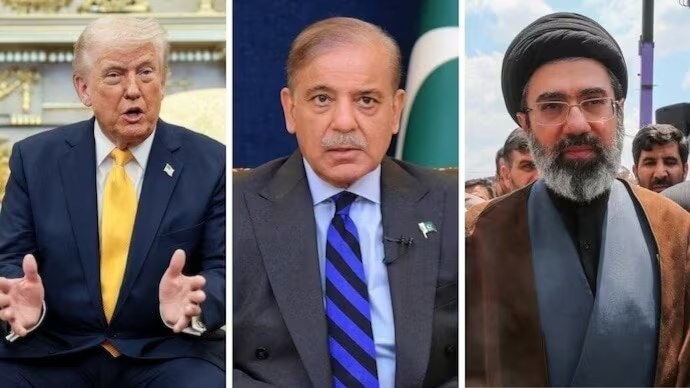
What Pakistan Is Doing Right Now
Here is the part of the story that every Pakistani should read, because it is genuinely remarkable.
Pakistan has good relations with Iran and is in a favourable position with the Trump administration, so the likelihood of some sort of breakthrough is possible. The next few days will be critical and will depend on how favourably the US responds to whatever the Iranian response is, according to Abbas Aslani, a senior research fellow at the Centre for Middle East Strategic Studies. Pakistan has good relations with Iran. Pakistan is in a favourable position with the Trump administration. That combination that unique, hard-won, carefully maintained combination — is the only reason this peace process exists at all. CNN
Iran’s latest answer to the US proposal is not a yes or no response but a clarification of Iranian views on the US text. If they can reach a kind of peace agreement at the initial stage, that could create a positive atmosphere and a trust-building measure, somehow, Aslani told Al Jazeera. Not a yes or no response. A clarification. This is diplomatic language for something important: Iran is not accepting or rejecting the American proposal outright. It is refining its own position and signalling where it has flexibility and where it does not. That is actually how successful negotiations work. You do not get a clean yes on the first exchange of documents. You get a series of clarifications that gradually narrow the gap until both sides can find language they can both live with. CNN
The problem is that Trump is not reading it as a clarification. He is reading it as rejection. And Pakistan — right now, today — is the only party positioned to convince both sides that the other is not as far away as their public statements suggest.
The Timeline That Got Us Here
It is worth stepping back and remembering how far this process has come, because the frustration of this week can make it easy to forget that something genuinely unprecedented has been happening here.
Delegations from the two countries first met in Pakistan for peace discussions exactly one month ago, on April 11. US and Iranian officials met for face-to-face talks in Islamabad lasting 21 hours. On April 12, Vance announced the sides had not reached an agreement. On April 13, the US implemented a blockade of Iranian ports. By April 21, Trump said he expected to continue bombing Iran if a deal to extend the ceasefire was not reached. Pakistan’s information minister said he was still trying to convince Iran to participate in talks. In the afternoon, Trump said he would extend the ceasefire until Iran submitted a proposal to end the conflict permanently. One month ago, these two countries were not talking at all. Today, they have exchanged detailed written proposals through a common intermediary. The gap between them is real and significant. But the existence of the channel itself — the fact that proposals are being exchanged, responded to, and responded to again — is something that did not exist before Pakistan made it possible. Al Jazeera
On April 7, Trump announced on Truth Social that he agreed to a two-week ceasefire with Iran and the proposal by Pakistan, stating that Iran will immediately open the Strait of Hormuz and work on finalising a peace agreement. Pakistan proposed the ceasefire. Trump accepted it. Iran accepted it. The war paused. That happened because of Pakistan. Whatever happens next, that fact cannot be taken away. CNN
Why This Week Matters More Than Any Other
Iran’s Foreign Ministry spokesman accused the United States of presenting unreasonable and one-sided demands in negotiations aimed at ending the US-Israel war on Iran as the two sides maintain a fragile ceasefire. Fragile ceasefire. On massive life support. These are not comfortable phrases to read on a Monday morning. But they are the reality of where things stand right now. ProPakistani
The next few days will determine whether the diplomatic process that Pakistan has held together for two months can survive this latest crisis of confidence. America needs to decide whether Trump’s public rejection of Iran’s proposal is his final word or his opening position in the next round of bargaining. Iran needs to decide whether its 14-point proposal is its floor or its ceiling. And Pakistan needs to do what it has done throughout pick up the phone, speak to both sides, and find the space between their positions where something workable might still exist.
It will not be easy. It has never been easy. But Pakistan has done harder things in this process than anyone expected, and it has done them without fanfare, without drama, and without ever walking away from the table.
The ceasefire is on life support. But it is still alive. And as long as it is alive, Pakistan will keep working to keep it that way.