One Assassination, One Question — What Does Hamas Do Now? On Friday evening in Gaza City, the Israeli Air Force carried out a strike. It hit a building and a vehicle in Al Remal. Seven Palestinians were killed.
Among them was Izz al-Din al-Haddad. He was the man Israel had hunted for years. And he was described as the last surviving architect of October 7. He is dead. By Saturday morning, mosque loudspeakers across Gaza announced his killing. His body was carried through the streets of Gaza City. It was wrapped in Hamas and Palestinian flags. Thousands attended his funeral. His family confirmed his death to the Associated Press. Hamas also confirmed it. Israel’s military confirmed it as well. The army chief of staff called it a significant operation. This may be an understatement.
Here is everything you need to know about who al-Haddad was, how Israel killed him, and what his death means for a conflict that has already cost more than 72,700 Palestinian lives.
Who was Izz al-Din al-Haddad
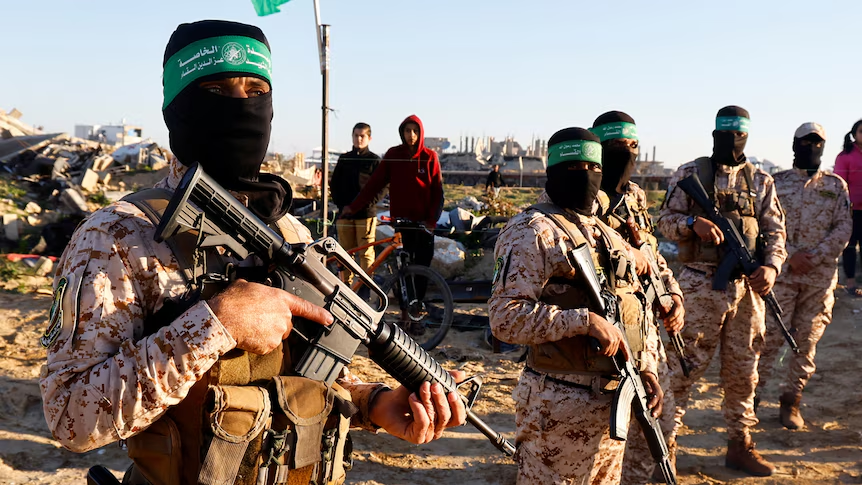
Haddad joined Hamas in the 1980s and became one of its longest surviving commanders. He had been a member of the terror group’s military wing since its founding in 1987. He previously led the Hamas Gaza City Brigade. During that time, the IDF said he directed the planning of the October 7 attack. He also oversaw combat operations against Israeli troops.
He spent nearly four decades in Hamas. This was not just a career. It was his entire life. He was part of the organisation from its early years. Many considered him one of its original architects. He survived several Israeli operations over time. Most of his peers did not last as long as he did. In the 1980s, he joined Hamas. Later, he became part of the Qassam Brigades’ Majd section. This unit targeted collaborators with Israel. He also served in Hamas’s Military Council. This is the group of top commanders. It played a major role in the attacks that started the war.
Haddad later rose to lead Hamas’s military wing. This happened after Mohammed Sinwar was killed in May 2025. Sinwar was the brother of Yahya Sinwar. He was also linked to the 2023 assault. According to the Wall Street Journal, Israel placed a $750,000 bounty on Haddad. He was targeted for his role in the attack. And he survived multiple assassination attempts before this.
He led Hamas’s military wing through a devastating war. Now he is gone.
How Israel Found Him And Killed Him
The operation that killed al-Haddad was not a lucky strike or a hasty decision. It was planned with extraordinary patience and precision. According to Israeli officials cited by The Jerusalem Post and The Times of Israel, the political leadership approved the strike about a week and a half before it was carried out, and intelligence teams kept Haddad under continuous surveillance during that period. Intelligence officers carried it out on Friday evening after identifying what officials described as a high-probability window for a successful elimination. Prior to the strike, the Air Force executed a deception operation intended to keep Hamas’s military wing and Haddad’s inner circle on low alert.
A deception operation. Israel spent the days before the strike deliberately lowering Hamas’s guard making it appear that no major operation was imminent while simultaneously tracking al-Haddad’s every movement. When the right moment came on Friday evening, the strike went in.
Throughout the war, Haddad managed the Hamas hostage captivity system and surrounded himself with Israeli hostages in an effort to prevent his elimination. The last 20 living hostages in Gaza were freed on October 13, 2025, as part of a US-brokered ceasefire deal, though the return of remains continued in the months that followed.
What Israel Is Saying
Israel’s response to the killing was triumphant and pointed. Eyal Zamir, the Chief of Staff of the Israeli military, said the assassination was a significant operational achievement. He held Israeli hostages with extreme cruelty. And he launched attacks against Israeli forces. He also refused to implement the agreement led by US President Trump. The agreement called for disarming Hamas and demilitarising the Gaza Strip.
Israel said this statement was significant. Israel framed it as accountability for October 7. It also linked al-Haddad’s killing to ongoing ceasefire negotiations. Israel said Hamas was refusing to disarm. This strike was also described as a message to Hamas leadership. It warned them about the consequences of not complying with the deal.
The news was widely welcomed in Israel. One of al-Haddad’s former Israeli captors spoke to Channel 12. He called it “a very happy moment.” And he said it was a message to Hamas that their time is up. He added that Israel would continue to act with full force.
Izz al-Din Haddad was the last of the Hamas senior officials who planned the October 7 massacre to be killed. The last. That word carries enormous weight. Every senior Hamas commander who planned October 7 is now dead. Yahya Sinwar. Mohammed Sinwar. And now Izz al-Din al-Haddad. Israel has systematically hunted down every architect of that attack over two and a half years. And on Friday evening, it finished the job.
What This Means for the Ceasefire
Here is the uncomfortable truth that nobody in Israel wants to focus on right now. The timing of this strike is deeply destabilising for the peace process.
The killing comes as the ceasefire between Israel and Hamas remains unstable, with major sticking points including the disarmament of Hamas continuing to complicate progress in negotiations. Israel’s assassination of Hamas’s military chief signals the possibility of a renewed war in Gaza, as Hamas holds up its objection to disarmament. Netanyahu holds his breath as US President Trump mulls a strategic decision that may reignite the war with Iran. A renewed war in Gaza. At the same moment, the US–Iran ceasefire hangs by a thread, peace talks in Islamabad have stalled, the Strait of Hormuz remains effectively closed, and the Middle East sinks deeper into dangerous instability.
The attack comes amid an increase in Israeli strikes on the strip, raising questions about the longevity of the ceasefire struck in October 2025. Netanyahu hinted at the possibility of more Israeli operations and land grabs in Gaza on Thursday, saying that Israel controls 60 per cent of the strip, but that tomorrow we shall see. The comments follow media reports that Israeli commanders are presenting the chief of the military with plans for renewed fighting in the strip. Tomorrow we shall see. Those four words from Netanyahu on Thursday, followed 24 hours later by the killing of Hamas’s military chief, are not coincidental. Israel is signaling loudly and publicly that the October ceasefire may be coming to an end on Israeli terms, not Hamas terms.
The IDF has already placed its Southern Command on heightened operational readiness in anticipation of a potential retaliatory strike by Hamas. Gaza City is braced for what comes next.
What Does Hamas Do Now.
The second possibility is that Hamas absorbs the strike, buries its dead, and returns to the negotiating table weakened, leaderless at the top, but still capable of making decisions. Hamas has survived the killing of Yahya Sinwar, Mohammed Sinwar, its political leadership in Qatar, and now its military chief in Gaza. The organisation is battered beyond recognition compared to what it was on October 6, 2023. But it still exists. And as long as it exists, some form of negotiation remains possible. What Hamas chooses to do in the next 48 hours will determine whether the Middle East is about to enter yet another phase of escalation or whether, somehow, the fragile architecture of the October ceasefire can survive this latest blow.
The ministry overall says Israel’s retaliatory strikes in the war have devastated the Palestinian enclave and killed more than 72,700 people. Seventy-two thousand, seven hundred people. Over two and a half years of war. An entire generation of Gaza’s population is living under bombardment, displacement, hunger and loss.
Whateveral-Haddad’s role in October 7, and whatever satisfaction Israel takes in his killing, that number sits above everything else as the true measure of this conflict’s cost. The assassination is complete. Now the question is what comes next. People will write the answer not in Israeli military communiqués or Hamas press releases, but in the streets of Gaza City in the hours and days ahead.
We will keep watching. Stay with us.