Trump Is in China RIGHT NOW — What Is He Doing There? Donald Trump has landed in Beijing. Right now, as you read this, the President of the United States is on Chinese soil for the first time in nearly a decade meeting Xi Jinping, touring the Temple of Heaven, attending a state banquet and trying to do in two days what his entire foreign policy team has been unable to do in two months. End the Iran war. Stabilise the global economy. And somehow come home with a deal that makes everyone look like a winner.
No pressure.
Here is everything happening in Beijing right now and why every single person on this planet, including every Pakistani watching their petrol prices, should be paying close attention.
Why Trump Is in China at All
This visit was originally scheduled for the first week of April. Then the Iran war started on February 28, the Strait of Hormuz closed, global oil markets went into chaos, and the image of Trump enjoying a lavish state visit in Beijing while American service members were dying in the Middle East became politically untenable.
Trump decided to hit pause shortly after the start of the Iran war. The image of Trump on a lavish state visit was increasingly seen at odds with a struggling US economy and the return of American service members killed in the Middle East. Al Jazeera
So the visit was delayed. And delayed again. And then, with the ceasefire on life support and the Iran deal going nowhere, the White House decided it could not wait any longer.
Months later, the war continues, yet the administration has ruled out any further delays. Experts see that as a signal of just how important China is to Trump even as they question whether the US currently has the leverage it needs to negotiate on a host of tense, tough issues including Taiwan, tariffs, artificial intelligence, fentanyl, rare earths and agriculture. Al Jazeera
Important enough to visit even mid-war. That tells you everything about how the White House views this relationship right now.
How Trump Arrived And Who He Brought With Him
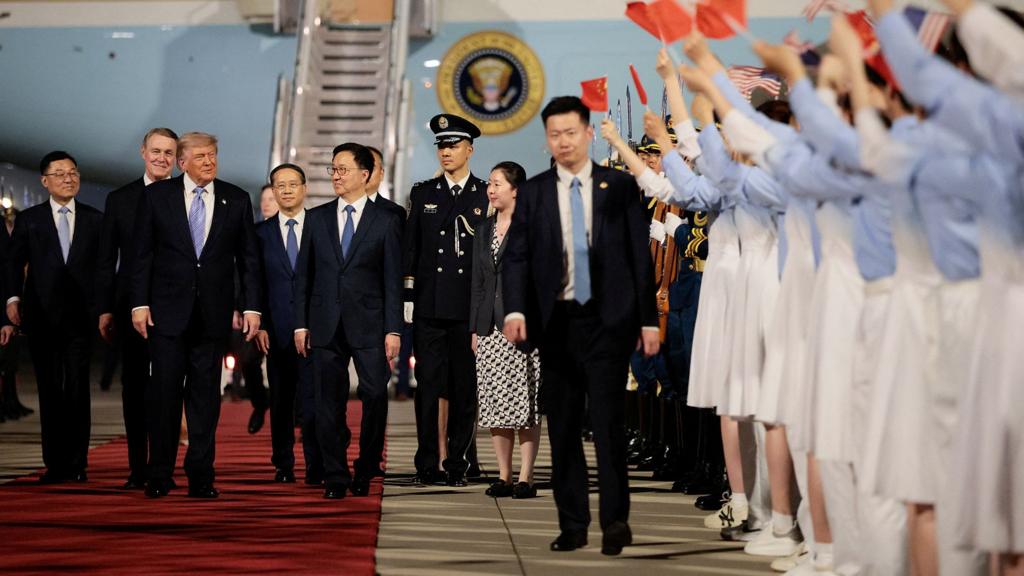
The arrival itself was a spectacle worth noting. Trump has landed in Beijing for the first visit to China by a sitting US president in almost a decade. He was greeted on the tarmac by a brass band and flag wavers who performed as he descended the steps of Air Force One. Google News
Trump is being accompanied on the trip by a group of executives from some of America’s most valuable companies, including Tesla CEO Elon Musk and Nvidia boss Jensen Huang. Think about that for a moment. Elon Musk, whose Tesla relies heavily on Chinese manufacturing, is standing on the tarmac in Beijing next to the American president. Jensen Huang of Nvidia, whose company has been at the center of the US-China chip war for years, is there too. Boeing executives. Mastercard. A who’s who of American corporate power, walking into the world’s second-largest economy with the most transactional president in American history.
This is not a diplomatic visit. It is a business trip with diplomatic packaging. And that framing tells you a great deal about what Trump actually wants to accomplish here.
What Is Actually on the Agenda
The high-stakes talks between the two leaders are expected to cover tariffs, rare earths, artificial intelligence, the Iran war and Taiwan.
Five massive topics in two days. Let us go through each one honestly.
Trade and Tariffs
This was supposed to be the main event before the Iran war complicated everything. Trump’s “Liberation Day” tariffs earlier this year sent US-China trade into freefall. Ever since Trump and Xi struck a trade truce at their October summit in South Korea, Trump has seemed determined to avoid antagonising his Chinese counterpart. He has pushed to allow China access to advanced AI chips, withheld arms packages for Taiwan, and repeatedly touted his excellent relationship with his good friend Xi. Al Jazeera
Experts are anticipating that Trump and Xi may announce large Chinese orders of American planes and soybeans when the meetings are concluded. Google News
Planes and soybeans. Big numbers that both leaders can point to as wins. That is how these summits work.
The Iran War
This is the wildcard that was not in the original script .China is credited with helping to push Iran to accept the initial ceasefire. Experts imagine Trump asking Xi to help pressure Iran to reopen the Strait of Hormuz and make a deal to end the war. Analysts expect Washington to press Beijing to use its influence over Tehran, particularly because China remains the largest buyer of Iranian oil by far purchasing more than 80 percent of Iran’s shipped crude exports.
Here is the uncomfortable reality that nobody in Washington wants to say out loud. America has spent two months trying to force Iran to the negotiating table through military strikes, a naval blockade, and Pakistan’s patient mediation. None of it has produced a final deal. The ceasefire is on life support. And now Trump is sitting across from the one person who might actually be able to move Iran because China buys 80 percent of Iran’s oil and Tehran cannot afford to ignore Beijing the way it can ignore Washington’s demands. Iran’s foreign minister recently went to China and met with his counterpart there. This inevitably changes the dynamic between Trump and Xi headed into this high-stakes visit. Al Jazeera
Iran’s FM was just in Beijing. And now Trump is in Beijing. That sequence is not a coincidence.
Taiwan
Trump announced he would have a discussion with Xi Jinping on the matter of arms sales to Taiwan, breaking with the Six Assurances. PBS
The Six Assurances are longstanding American commitments to Taiwan about arms sales and sovereignty. Trump is apparently prepared to put those on the table. That is an enormous concession, and it signals just how much Trump wants or needs something from Xi right now.
AI and Technology
They may also discuss AI technology, at least to establish some channels of deconfliction. The technology war between the US and China has been one of the defining features of global politics for the past several years. NVIDIA chips. Huawei. Export controls. Both sides know that some form of managed coexistence on AI is better than pure conflict — but agreeing on what that looks like in practice is genuinely difficult.
Why This Visit Is Deeply Unusual Even by Trump Standards
It is remarkable that President Trump is prepared to go to China under these circumstances, said Kurt Campbell, chairman of The Asia Group. But may I also say that it is also deeply unusual that China is prepared to host him. China and Iran are close allies and trading partners, and the US has just spent weeks bombing Iran and is now blockading all ships connected to Iran. Meanwhile there are questions about whether China has assisted Iran. And yet the state visit is moving ahead as planned. It suggests that both believe they have interests in meeting, a desire to keep a relationship that is fraught and challenging with a degree at least. Al Jazeera
Both believe they have interests in meeting. That sentence is the key to understanding why this visit is happening despite everything. America and China are rivals. They both know it. But they are also deeply, structurally dependent on each other in ways that neither can easily undo. Trade. Technology. Energy. Climate. Iran. Taiwan. Every single major issue of our time has both countries in it.
Yue Gang, a retired Chinese colonel, said Trump originally intended to visit China with the air of a swift victor. But the war has significantly diminished the US military’s ability to project its combat power, leaving Trump unable to project the same arrogance. Trump came to Beijing expecting to be in a position of strength. The Iran war changed that. He arrives not as a conqueror but as a president who needs something from China specifically, Beijing’s help in getting Tehran to make a deal.
What Pakistan Should Be Watching
For Pakistanis following this story, the China visit has direct implications that go beyond the headlines. Some experts state that the ongoing Iran war could give China greater leverage when dealing with Donald Trump, given that the US had diverted resources away from South Korea and Japan to the Middle East.
China, with greater leverage over Trump, is a development that affects the entire region, including Pakistan. CPEC, Pakistan’s relationship with both Washington and Beijing, the regional security architecture all of it gets touched by whatever happens in that meeting room in Beijing over the next two days.
And there is the petrol price angle that every Pakistani feels personally. About half of China’s crude oil imports come from the Middle East, while disruptions in the Gulf have left commercial shipping vulnerable to attacks and delays. If Trump convinces Xi to pressure Iran on the Strait of Hormuz, and if that produces a deal that finally reopens the strait properly, oil prices could fall significantly and Pakistan’s fuel costs could drop within weeks.
If the meeting produces nothing meaningful on Iran, the strait stays effectively closed, oil stays above $100 a barrel, and Pakistani petrol prices stay painfully high.
What Happens Next
Trump is scheduled to participate in a welcome ceremony and hold a bilateral meeting with Xi, before touring the historic Temple of Heaven and attending a state banquet. He will leave China on Friday following tea and a working lunch with Xi.
Two days. Temple of Heaven. State banquet. Working lunch. Trade deals. Iran pressure. Taiwan concessions. AI deconfliction. Trump said his trip to China will be a wild one.
For once, that is probably an understatement. We will be updating this story as the meetings unfold. Stay with us.