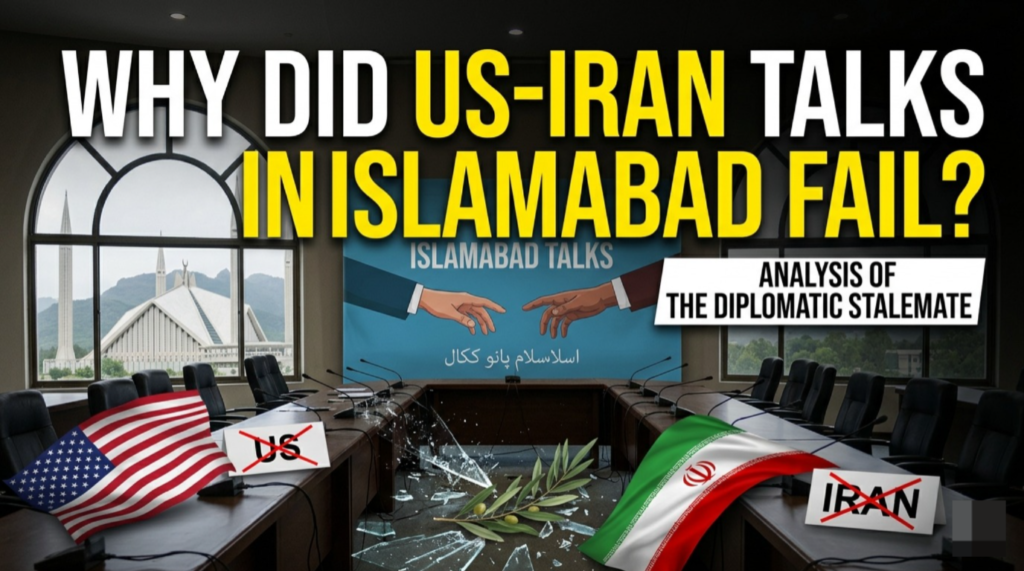
Why Did US-Iran Talks in Islamabad Fail? Let’s be honest — nobody really expected Pakistan to pull this off. Getting the United States and Iran into the same room, in the same city, actually talking to each other face to face? That hadn’t happened since 1979. And yet, on April 11, 2026, it happened. Right here in Islamabad.
For a moment, it felt like something big was about to happen. Like history was being written in our capital.
It wasn’t.
After more than 21 hours of intense negotiations, both delegations packed their bags and went home without a deal. JD Vance flew out of Islamabad. The Iranian delegation left quietly. And the rest of us were left wondering — what on earth just happened?
Pakistan Did Its Part
Before we talk about why it failed, let’s give credit where it’s due. Pakistan worked for weeks behind the scenes to make these talks happen. Foreign Minister Ishaq Dar was on the phone constantly, reassuring both sides, making promises and building trust. Prime Minister Shehbaz Sharif personally backed the effort.
This was not easy. The US and Iran have not had normal diplomatic relations for nearly half a century. The fact that Islamabad managed to get both sides into the same building — talking, actually talking — was itself a massive achievement. Most countries in the world couldn’t have done that. Pakistan did.
So the failure of these talks is not Pakistan’s failure. It’s bigger than that.
The Real Problem? Both Sides Think They Won the War
Here is the thing nobody is saying loudly enough. The 40-day war between the US and Iran ended in a ceasefire — not a clear victory for either side. But both Washington and Tehran are walking around acting as if they won.
And when both sides believe they have the upper hand, nobody wants to give anything up.
The Americans came into Islamabad with a 15-point plan. Iran brought its own 10-point counter-proposal. On paper, it sounds like a negotiation. In reality, both sides were miles apart on almost everything that mattered.
The US wanted the Strait of Hormuz reopened immediately. Iran said no. The US wanted hard commitments on Iran’s nuclear programme before signing anything. Iran pushed back. Iran wanted compensation for war damages. America walked away from that conversation entirely. Iran demanded that Israeli strikes on Lebanon stop as part of any deal. The Americans weren’t ready to go there either.
By the time talks ended in the early hours of Sunday morning, it was clear that neither side had moved much at all.
They Were This Close — And Then It Fell Apart
Here is the part that is genuinely painful to read. Sources close to the talks have confirmed that at one point, both sides were actually close to signing a Memorandum of Understanding. An MoU. A piece of paper. Something.
But then, right at the last moment, it collapsed. Last-minute demands, shifting positions, trust issues that run decades deep — all of it came crashing down in those final hours.
JD Vance stood before cameras afterward and said the breakdown was far worse for Iran than for America. Iran’s Parliament Speaker Ghalibaf said his side came with good faith but found the other side impossible to trust. Both of them were probably telling their own version of the truth.
That’s how deeply broken this relationship is. Even when they almost agree, they can’t quite get there.
Then Trump Made Things Worse
Just hours after the talks collapsed, President Trump went on social media and announced that the US Navy would blockade the Strait of Hormuz. No ships in. No ships out. Without American permission.
Iran’s response was immediate and sharp, warning that no port in the Gulf or the Sea of Oman would be safe if a blockade was imposed.
In one afternoon, the situation went from a failed negotiation to something that looked dangerously close to the edge again.
Why Should Pakistanis Care?
Some people might read all this and think. This is America and Iran’s problem, not ours. But that thinking is wrong, and here’s why.
The Strait of Hormuz is one of the most important waterways on the planet. Nearly one-fifth of the world’s oil passes through it every single day. When it gets blocked, oil prices go up everywhere. And when oil prices go up, petrol prices in Pakistan go up. Electricity bills go up. The price of flour, vegetables, transport — everything goes up.
We are already struggling. Another round of war in that region could push Pakistan’s economy into even more difficult territory. This is not a distant foreign problem. It lands in our homes, in our kitchens, in our wallets.
What Happens Now?
The ceasefire between the US and Iran expires on April 22. That’s days away. Foreign Minister Dar has said Pakistan will keep trying to bring both sides back before that deadline. Whether either side listens is another question entirely.
Experts are warning that if the ceasefire breaks down and fighting resumes, getting back to the negotiating table becomes almost impossible. War changes everything. Positions harden. Options disappear. And ordinary people on all sides pay the price.
Pakistan did what it could. It brought the world’s two most stubborn negotiators into the same room. That matters. But peace requires more than a venue — it requires a willingness to bend. And right now, neither Washington nor Tehran seems ready to do that.
We can only hope they come to their senses before April 22.